

Table of Contents
- Why Fake Online Reviews Are Getting Harder to Spot in 2026
- Signs of Fake Product Reviews: A 60-Second Consumer Checklist
- Fake Review Examples: What Fabricated Feedback Actually Looks Like
- How to Verify Reviews Across Marketplaces and Platforms
- Fake Review Checker Tools: How to Use Them Responsibly
- Conclusion: Shop Smarter, Not Sceptically
- Frequently Asked Questions
Last Updated: October 5, 2026
Why Fake Online Reviews Are Getting Harder to Spot in 2026
Fake online reviews are fabricated or paid customer reviews posted to mislead shoppers about a product or business. This guide from GrabIT covers how to avoid fake online reviews with a simple checking routine you can run in under a minute.
Shoppers lose money, time, and trust when reviews lie. The problem is scale. Review platforms rely on automated moderation, and bad actors have learned to write like real customers.
So how do you avoid fake online reviews without becoming a full-time detective? You do not need to. You need a repeatable process.
Below, we'll show you exactly how to spot the warning signs and verify reviews across platforms.
Signs of Fake Product Reviews: A 60-Second Consumer Checklist
The fastest way to spot fake reviews is to scan for patterns, not individual comments. A single glowing review means nothing. A cluster of them, posted the same week, with the same tone, means something.
Run this checklist before you buy:
- Reviewer profile: No photo, no history, or an account created this month
- Review count: The reviewer has posted ten reviews in two days
- Wording: Vague praise like "great product, fast shipping" with zero detail
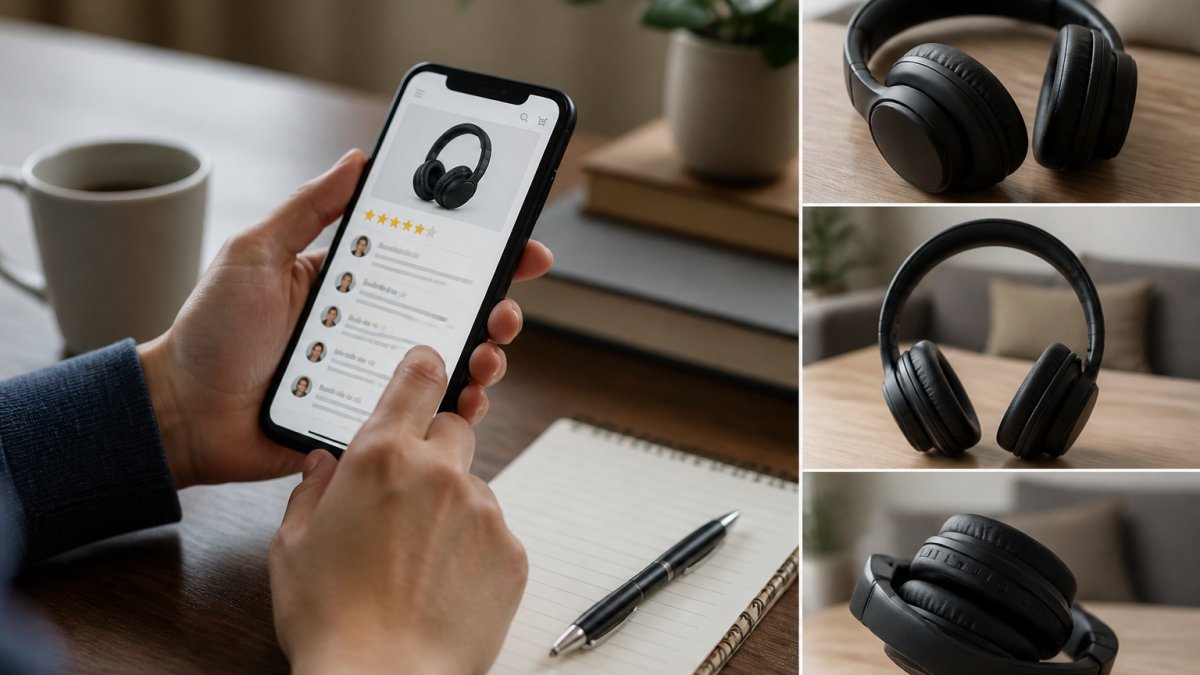
Red Flags in Reviewer Profiles and Review History
A reviewer profile is the account page showing a person's past reviews, ratings, and activity history. It is the single most useful tool you have.
Click the name. Then check three things:
- Does this person review only one brand's products?
- Do their reviews all sound the same?
- Did the account appear right before a wave of positive posts?
A real shopper's history is messy. They review a phone case, then a dog leash, then complain about a delayed delivery. A fake profile is narrow and consistent.
Language, Dates, and Volume Patterns That Give Fakes Away
Generic wording is the giveaway most people miss. Real customers mention specifics: the zipper stuck, the color ran, the battery lasted two days. Fake reviews stay broad on purpose, because the writer never touched the product.
Watch the dates too. A burst of reviews in a short window suggests a coordinated push. So does a sudden flood of five-star ratings on a product with no sales history.
Fake Review Examples: What Fabricated Feedback Actually Looks Like
Fake review examples fall into two buckets: fake positive reviews and fake negative reviews. Both distort your purchase decision, just from opposite directions.
Here is what each looks like in the wild.
Fake Positive Reviews and Incentivized Praise
Incentivized reviews are written in exchange for a free product, a discount, or a refund. The reviewer may never disclose the deal. The result reads like marketing copy, not a customer experience.
Common tells:
- Superlatives with no evidence ("best purchase of my life")
- Emotional language that never names a feature
- A review posted the same day the item shipped
These reviews inflate star ratings and push mediocre products to the top of search results.
Fake Negative Reviews and Defamatory Attacks
Fake negative reviews are often aimed at hurting a competitor or damaging a business's reputation. They may come from someone who never bought the product.
Signs include:
- Claims with no order detail or timeline
- Personal attacks on staff rather than the product
- Identical complaints posted across multiple platforms
- A review from an account with no other activity
Some of these cross into defamation, which is a false statement that harms a business's reputation. That is a legal matter, not just a platform one.
How to Verify Reviews Across Marketplaces and Platforms
Verifying reviews means checking the same product on more than one site. No single platform tells the full story.
Start with these steps:
- Search the product name plus "review" and read results outside the store page.
- Check independent review sites and forums for longer-term feedback.
- Look for a "verified purchase" label and confirm the platform actually enforces it.
- Compare the star rating on the seller's site with ratings elsewhere.
- Read the three-star reviews first. They are usually the most honest.
A big gap between a seller's own rating and reviews elsewhere is a trust signal worth noting. So is a product with hundreds of reviews on one site and none anywhere else.
Check |
What Good Looks Like |
What Raises Doubt |
|---|---|---|
Star rating |
Consistent across sites |
4.9 on one site, 3.2 elsewhere |
Review dates |
Spread over months |
Clustered in one week |
Reviewer history |
Mixed, varied activity |
Single-brand accounts |
Verified badge |
Clearly enforced |
Label missing or unclear |
Review detail |
Names features and use |
Generic praise only |
Fake Review Checker Tools: How to Use Them Responsibly
Fake review checker tools scan review text for patterns that suggest manipulation. They flag repeated phrases, suspicious timing, and unusual rating spikes. Some are browser extensions that overlay a score on a product page; others are dashboards that analyze a batch of reviews you paste in. The useful ones explain why they flagged something, not just that they did.
They are useful, but limited. Here is how to use them well:
- Treat a flag as a prompt to look closer, not a verdict
- Never rely on one tool's score alone
- Check whether the tool explains its reasoning
- Remember that tools miss clever, well-written fakes
How These Tools Actually Work
Most checkers use a mix of signals: n-gram overlap (repeated phrases across reviews), burst detection (many reviews in a short window), rating distribution skew, and sometimes reviewer-account age. A tool that only looks at text will miss a well-written fake posted by a brand-new account.
The honest limitation: no checker can prove a review is fake. It can only show that a pattern looks unusual. Your judgment still decides.
False Positives and Privacy Trade-Offs
False positives are real. A small business with a genuinely loyal customer base can trigger burst detection after a launch. A product with a niche audience can look like it has repetitive wording because buyers use the same technical terms.
Privacy matters too. Many free extensions request broad permissions to read page data. Before installing one, check what data it collects and whether it sends review text to a server.
At GrabIT, our catalog across electronics, pet supplies, and household goods is built for shoppers who read before they buy.
Platform Policies Differ More Than You Think
Some platforms remove reviews that break their guidelines, others only act on clear fraud, and a few will not remove a review just because it is negative or unfair.
If you are a business facing a false or defamatory review, you can dispute it directly and, in serious cases, seek legal advice. For shoppers, reporting is still worth the two minutes.
This is where a clear return policy matters. At GrabIT, our no-hassle returns exist to help the customers throughout their shopping journey with us. The best defense is still prevention. Check profiles, read the middle reviews, and cross-reference before you click buy.
Conclusion: Shop Smarter, Not Sceptically
The goal is not to distrust every review. It is to read them like a skeptic with a system. Check the reviewer, the wording, the dates, and the platform. Do that, and the fakes lose their power.
At GrabIT, we make that easier with a curated range across electronics, pet supplies, and everyday essentials, plus a no-hassle return policy and on-time delivery for seasonal items.
Frequently Asked Questions
How can you tell if an online review is fake?
Look for a combination of signals rather than one giveaway. Check whether the reviewer has a history of only five-star ratings, whether the wording is generic or repeats phrases from other reviews, and whether the review was posted in a burst alongside dozens of others on the same day. Verified purchase badges help but are not conclusive. Cross-check the same product on two or three platforms: if ratings swing wildly between sites, that is a strong sign of review manipulation.
Are verified-purchase reviews always reliable?
No. A verified purchase badge confirms a transaction happened, not that the review is honest. Sellers sometimes buy their own products or use incentivized reviews, where a buyer is offered a refund or gift in exchange for a positive rating. Those reviews can still carry a verified badge. Treat the badge as one trust signal among several, and weigh it alongside reviewer history, language specificity, and how the review compares with feedback on other platforms.
What should you do if you find fake reviews?
Document the review first: take a screenshot showing the text, reviewer name, date, and star rating. Then use the platform's report or flag option, selecting the category that best fits, such as 'not a genuine customer' or 'incentivized review.' Or contact the retailer's customer service directly.
Which tools can help identify suspicious reviews?
Several fake review checker tools analyse review text for repetitive phrasing, posting patterns, and reviewer account age. Fakespot and ReviewMeta are two well-known options, though their accuracy varies by platform and product category. Use them as a starting point, not a final verdict: a tool flagging a product does not prove fraud, and a clean score does not guarantee authenticity. Always combine tool output with your own checks on reviewer profiles and cross-platform ratings.